
The Hour of Mercy and The Chaplet
In His revelations to St. Faustina, Our Lord asked for a special prayer and meditation on His Passion each afternoon at the three o’clock hour, the hour that recalls His death on the cross.
At three o’clock, implore My mercy, especially for sinners; and, if only for a brief moment, immerse yourself in My Passion, particularly in My abandonment at the moment of agony. This is the hour of great mercy. In this hour, I will refuse nothing to the soul that makes a request of Me in virtue of My Passion (Diary, 1320).
As often as you hear the clock strike the third hour, immerse yourself completely in My mercy, adoring and glorifying it; invoke its omnipotence for the whole world, and particularly for poor sinners; for at that moment mercy was opened wide for every soul. In this hour you can obtain everything for yourself and for others for the asking; it was the hour of grace for the whole world — mercy triumphed over justice. (1572)
My daughter, try your best to make the Stations of the Cross in this hour, provided that your duties permit it; and if you are not able to make the Stations of the Cross, then at least step into the chapel for a moment and adore, in the Most Blessed Sacrament, My Heart, which is full of mercy; and should you be unable to step into the chapel, immerse yourself in prayer there where you happen to be, if only for a very brief instant. (1572)
From these detailed instructions, it’s clear that Our Lord wants us to turn our attention to His Passion at the three o’clock hour to whatever degree our duties allow, and He wants us to ask for His mercy.
In Genesis 18:16-32, Abraham begged God to reduce the conditions necessary for Him to be merciful to the people of Sodom and Gomorrah. Here, Christ Himself offers a reduction of conditions because of the varied demands of our life’s duties, and He begs us to ask, even in the smallest way, for His mercy, so that He will be able to pour His mercy upon us all.
We may not all be able to make the Stations or adore Him in the Blessed Sacrament, but we can all mentally pause for a “brief instant,” think of His total abandonment at the hour of agony, and say a short prayer such as “Jesus, Mercy,” or “Jesus, for the sake of Your Sorrowful Passion, have mercy on us and on the whole world.”
This meditation, however brief, on Christ’s Passion brings us face-to-face with the cross, and, as Pope John Paul II writes in Rich in Mercy, “It is in the cross that the revelation of merciful love attains its culmination” (8). God invites us, the Holy Father continues, “to have ‘mercy’ on His only Son, the crucified one” (8). Thus, our reflection on the Passion should lead to a type of love for Our Lord which is “not only an act of solidarity with the suffering Son of man, but also a kind of ‘mercy’ shown by each one of us to the Son of the Eternal Father.”
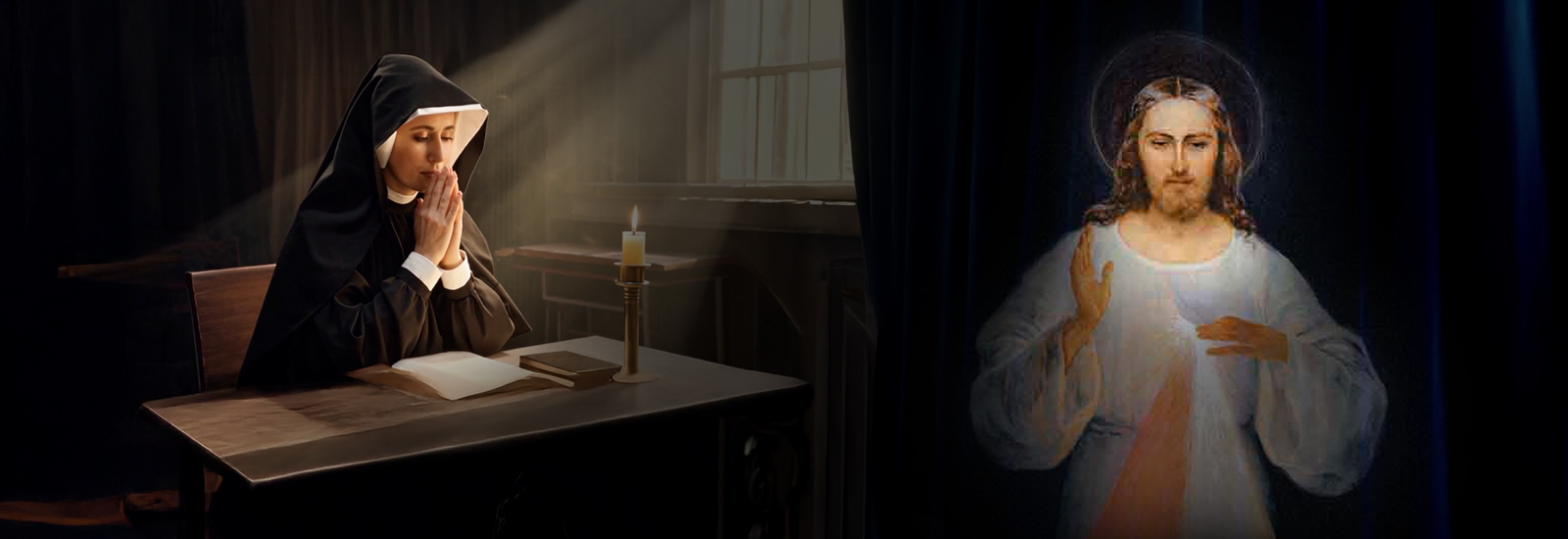
In 1935, St. Faustina received a vision of an angel sent by God to chastise a certain city. She began to pray for mercy, but her prayers were powerless. Suddenly she saw the Holy Trinity and felt the power of Jesus’ grace within her. At the same time she found herself pleading with God for mercy with words she heard interiorly:
Eternal Father, I offer You the Body and Blood, Soul and Divinity of Your dearly beloved Son, Our Lord Jesus Christ, in atonement for our sins and those of the whole world; for the sake of His sorrowful Passion, have mercy on us. (Diary, 475)
As she continued saying this inspired prayer, the angel became helpless and could not carry out the deserved punishment (see 474). The next day, as she was entering the chapel, she again heard this interior voice, instructing her how to recite the prayer that our Lord later called “the Chaplet.” This time, after “have mercy on us” were added the words “and on the whole world” (476). From then on, she recited this form of prayer almost constantly, offering it especially for the dying.
In subsequent revelations, the Lord made it clear that the Chaplet was not just for her, but for the whole world. He also attached extraordinary promises to its recitation.
Encourage souls to say the Chaplet which I have given you (1541). Whoever will recite it will receive great mercy at the hour of death (687). When they say this Chaplet in the presence of the dying, I will stand between My Father and the dying person, not as the just Judge but as the Merciful Savior (1541). Priests will recommend it to sinners as their last hope of salvation. Even if there were a sinner most hardened, if he were to recite this Chaplet only once, he would receive grace from My infinite mercy (687). I desire to grant unimaginable graces to those souls who trust in My mercy (687). Through the Chaplet you will obtain everything, if what you ask for is compatible with My will. (1731)
Prayed on ordinary rosary beads, The Chaplet of The Divine Mercy is an intercessory prayer that extends the offering of the Eucharist, so it is especially appropriate to use it after having received Holy Communion at Holy Mass. It may be said at any time, but our Lord specifically told St. Faustina to recite it during the nine days before the Feast of Mercy (the first Sunday after Easter). He then added: “By this Novena, [of Chaplets] I will grant every possible grace to souls.” (796)
It is likewise appropriate to pray the Chaplet during the “Hour of Great Mercy” — three o’clock each afternoon (recalling the time of Christ’s death on the cross). In His revelations to St. Faustina, Our Lord asked for a special remembrance of His Passion at that hour.